
Taurism
Ernest Hemingway's The Sun Also Rises: And Stories from In Our Time and Men Without Women

Note: My piece on John Updike and his letters for The Metropolitan Review.
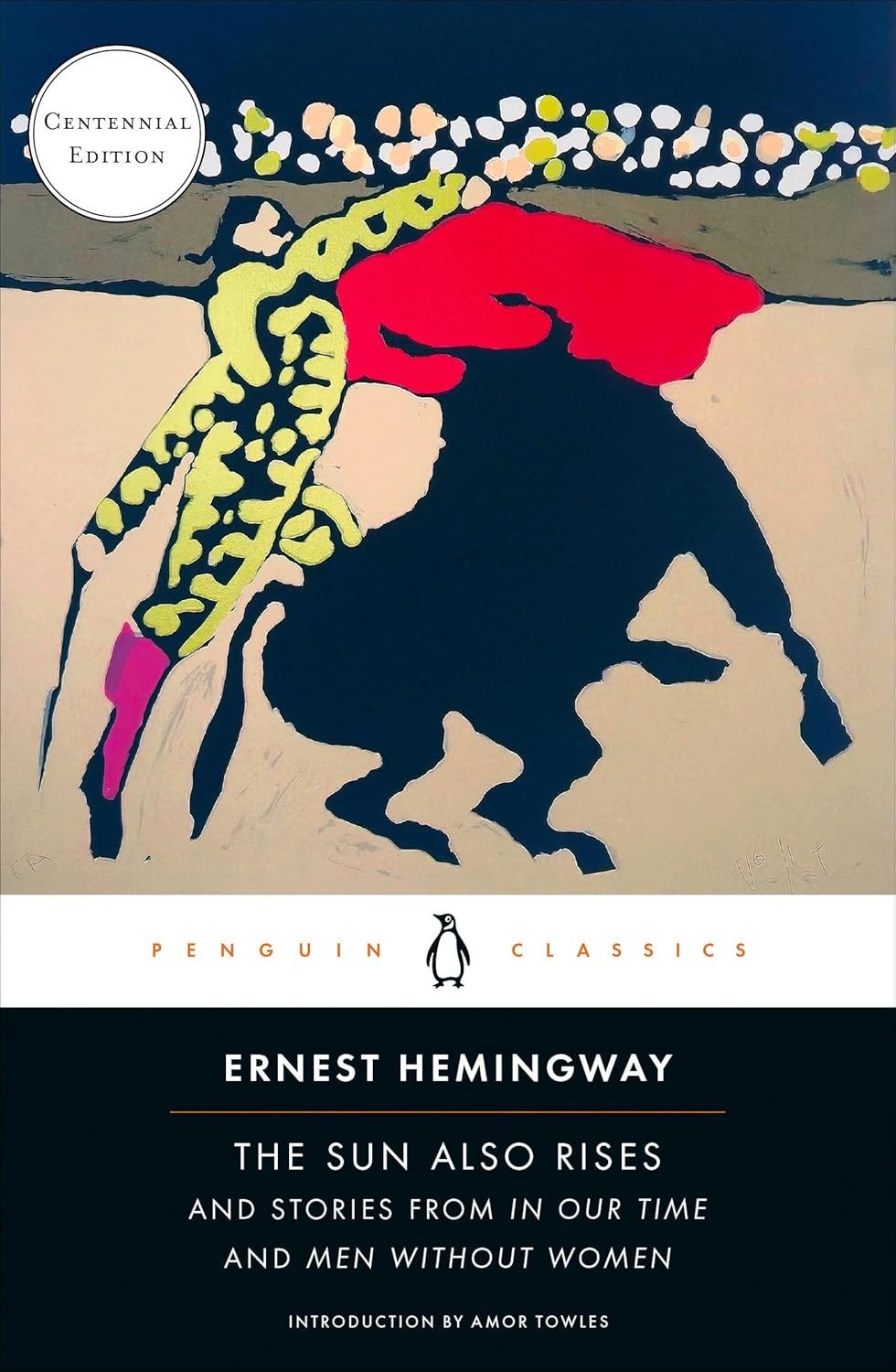
The Sun Also Rises: And Stories from In Our Time and Men Without Women. By Ernest Hemingway. New York: Penguin Classics, 2026. 320 pp. $18.
In 1929, about two and a half years after the publication of The Sun Also Rises, Ernest Hemingway writes the following in a letter to the novelist Owen Wister:
My life was more or less shot out from under me and I was drinking much too much entirely through my own fault. I was writing better and getting so I could link up sentences occasionally instead of having them all go put put put— Then wrote The Sun Also in 6 weeks— It contains much garbage but no smut and what I hoped to do was contrast the people, most of whom were pretty lousy, with the country which was pretty fine. I tried to give the destruction of character in the woman Brett—that was the main story and I failed to
get it acrossdo it.So I thought the Pamplona part was all right and the rest interesting enough to carry it even though to me it was a failure and I wouldnt have published it except that that was the only way I could get it behind me.
So much for that. The first installment of A Farewell to Arms was soon to be published in Scribner’s Magazine, and Hemingway was worried enough about the new book that he could nearly dismiss the old one. The Sun Also Rises, though, now has the highest reputation of his novels: A Farewell to Arms, as a kind of boy’s adventure story, can’t be taken quite as seriously, and later candidates like For Whom the Bell Tolls and The Old Man and the Sea are understood to issue from a different pen, a much celebrated Hemingway who was self-conscious in the bad way and even reliant on something like self-impersonation. Anthony Powell, who must have read Hemingway before he wrote The Afternoon Men, called The Sun Also Rises “the sole book in which he takes an interest in other people, while himself, so to speak, participating.” The narrator Jake Barnes, a journalist older than Hemingway but like him wounded in World War I, is a confidante of and liaison between the other more adventurous characters, and because of where he is wounded, he cannot get involved as they do. He loves Brett, Lady Ashley, but he will not be one of her lovers. He leads his Princeton friend Robert Cohn, Bill Gorton, another writer, and Brett with her new fiancé Mike Campbell through the fiesta in Pamplona and into the bullring, but as the tour-guide, he doesn’t banter and bicker quite so freely as the rest. He is that odd sort of first person narrator who briefly goes quiet at dinner and almost disappears, and although he is confident and generous in his telling of the story, slowing here and there to take in the many sights, there are little slips of memory and uncertainties that give the novel yet more life. It would be very difficult to see it, as Hemingway did, as any kind of failure.
For their Centennial Edition, Penguin have seen fit to package The Sun Also Rises with those interludes or vignettes from the earlier collection In Our Time that involve bullfighting, and with five of the stories from his next book, Men Without Women. Amor Towles’ introduction to the Classics Deluxe Edition from 2022, which sweats, insists, and repeats like an essay by a college freshman, is brought back. There is a new and helpful note on the stories by the editor, Ross K. Tangedal of the University of Wisconsin-Stevens Point. The dedication and epigraphs from The Sun Also Rises are placed before the table of contents for the whole book: it seems as if the stories have been included mainly to get closer to three hundred pages. An annotated and illustrated centennial edition of the novel, with its own new introduction by Adam Gopnik, some Hemingway letters, and the original two opening chapters, will be published by the Library of America in October of this year, but it will cost $39.95.
To return, Jake Barnes is a somewhat cautious and questioning narrator, sure that the story is worth telling but not that he has everything right. We soon know that for him it is “easy to be hard-boiled about everything in the daytime, but at night it is another thing.” (His term “hard-boiled” reminds us how Hemingway would be the model for action and dialogue in the work of Dashiell Hammett, James M. Cain, etc.) When he gets to a Paris scene with Cohn in Chapter VI, he realizes he has missed something: “Somehow I feel I have not shown Robert Cohn clearly.” He then explains that Cohn’s desperate love for Brett has made him say odd things, and ruined his tennis game. (This passion might even bring out the pugilism that we learned of in the first pages, in the review of his college boxing career.) Late night at Zelli’s in Montmartre, there is a confusion of voices between the dancing Jake and Brett, and a chanting drummer whose lines are represented by ellipses. This is the confusion of crapulence, to be sure, but also over the meaning of Jake’s and Brett’s unconsummated affair. She is pretty lousy, but somehow at the same time too good for all these men circling her. Right after Jake and Bill get to Spain for their trout-fishing, there is an odd moment of self-correction when Jake renews his subscription for bull-fight tickets from an old man: “He was the archivist, and all the archives of the town were in his office. That has nothing to do with the story. Anyway, his office had a green baize door . . .” One pictures Hemingway at his typewriter, rattling away for the last few weeks at around 1500 words per day, stopping to wonder if the old man’s archiving is important enough, and deciding with a grunt to leave in this tangential little sentence and turn his way back to the story. Boyish as Hemingway may be, this is not the affected talkiness of a young narrator who gives humorous comment when straying off-piste; it is part of Hemingway’s gruffness and hardness, a correcting and disciplining of himself. But the admission of error and uncertainty makes The Sun Also Rises more expansive.
The slips are significant because the true masculine principle in Hemingway, to go with the obvious ones of action and physical courage, is simply knowing things, and with more experience understanding them in a way that lessers cannot. The authoritative, slightly tetchy bullfighting aficionado is a role of Jake’s which Hemingway would turn into a persona in his book on bullfighting, Death in the Afternoon. In The Sun Also Rises, Jake teaches us another thing, the etymology of that imported Spanish specialty: “Aficion means passion. An aficionado is one who is passionate about the bull-fights.” Montoya, the owner of the hotel where the gang stay in Pamplona, is such a man, and Jake in his serious talks with him and other guests proves that an American can be an aficionado. Shared expertise in bullfighting is a spiritual brotherhood, Jake explains, and a good talk leads to a hand on the shoulder and the commendation “buen hombre”. Other knowledges, of fishing, food, wine, and war, carry the same sense of honor, though not as far. The bullfights (a misleading translation of Corrida de toros) are the dramatic highs of the novel, not because the hero participates—he is only a spectator—but because of what he and his brothers can see in them. This is why, in the short story “The Undefeated” included here, Hemingway cuts away from the bullfight and shows us the bullfighting critic who as he keeps reminding us is only the substitute or second-stringer for El Heraldo:
He had decided it was not worth while to write a running story and would write up the corrida back in the office. What the hell was it anyway? Only a nocturnal. If he missed anything he would get it out of the morning papers. He took another drink of the champagne. He had a date at Maxim’s at twelve. Who were these bull-fighters anyway. Kids and bums. A bunch of bums.
The declining matador Manuel Garcia, humbled but still proud, is heroically suffering and struggling, but this merely professional spectator isn’t bothered. In The Sun Also Rises, Jake, an altogether more sensitive sort, sees in the once great Belmonte something of tragedy and dignity:
Belmonte was no longer well enough. He no longer had his greatest moments in the bull-ring. He was not sure that there were any great moments. Things were not the same and now life only came in flashes. He had flashes of the old greatness with his bulls, but they were not of value because he had discounted them in advance when he had picked the bulls out for their safety, getting out of a motor and leaning on a fence, looking over at the herd on the ranch of his friend the bull-breeder.
Jake knows that Belmonte is “sick with a fistula” and is sometimes overwhelmed with pain. The crowd, whether they know this or not, demand the old Belmonte routine, which means working closer to the bull and to danger, and when they sense that things are not the same now, they jeer and throws vegetables at him. However cautious he must now be, his fighting has “sincerity”, as Jake quietly acknowledges. Jake knows as much as of bull-fighting technique and convention as the critic, and it falls to him to explain it to Brett; she is to have an affair with one of the bullfighters, and like him is able to see a lot more in bullfighting than just technique.
The clarity of life in the bullring is set off by contrast with the chaos of the fiesta and the gang’s mad, reckless partaking. Jake knows what he sees in there, while outside, among his drunken friends whose dialogues sometimes verge on the surreal, there is much confusion. Watching the fights, Jake can glimpse flashes of greatness, even greatness compromised, and these are the third part of the scheme he lays out to Owen Wister: mostly human lousiness and the fine country, but here and there human greatness. Like a good literary critic, Jake explains to Brett why she likes what she likes. Romero, the young matador she will run off with, “avoided every brusque movement”, working close to the bull, always “straight and pure and natural in line”. The danger is real for him, or at least he can make it look real. He has noble qualities lacking in Jake, Robert, Bill, and Mike, so Jake, in the odd position of being able to see them, helps Romero and Brett find each other, only to be called a “pimp” the next morning. All the fighting over the woman has to do with greatness, too. Brett is not great, she cannot confer greatness, and she cannot be kept for long as a trophy in recognition of it, but she has the terribly important power of seeing it and choosing it.
The Sun Also Rises was written quickly, and it had to be. The relevance of Hemingway’s work in journalism to his fiction is probably overrated, but he did write his stories and novels with a deadline, needing to get his experience down onto paper before it died. There it somehow has the freshness of a spring and the hardness of stone. In A Farewell to Arms, he will start with a worthier story and give his book more of a dramatic shape, but the younger Frederic Henry, not wounded from the beginning, is a more assured storyteller who lacks Jake’s interesting and perhaps mature self-doubt. That hero gets in trouble but he always has a writer’s mastery of the situation, with a hint of retrospective wisdom. Not so in The Sun Also Rises, competent and knowing as Jake may be. Noticing his lapses and limits, we are drawn further in, made privy to a life that goes on in situ with its odd and unordered perceptions as the mad world continues in its usual way: “There was a crowd of kids watching the car, and the square was hot, and the trees were green, and the flags hung on their staffs, and it was good to get out of the sun and under the shade of the arcade that runs all the way around the square.” We are down to the essentials, to the heat and the greenness and the shade, and these are universals, too, but they are his universals. This is not all: the language is enveloped in a living silence. Whatever riotous noise and color assault the senses, there is inside Jake a private quietness, a separate peace, you could say, and Hemingway’s technique is bringing us toward it. The retreat is needful: the eye is not satisfied with seeing, nor the ear filled with hearing.