
Continental Drift
Elizabeth Bowen's The Hotel

Note: My reviews of James Bailey’s Like a Cat Loves a Bird: The Nine Lives of Muriel Spark for Pittsburgh Review of Books, and of Mark Haber’s Lesser Ruins for MQR Online.
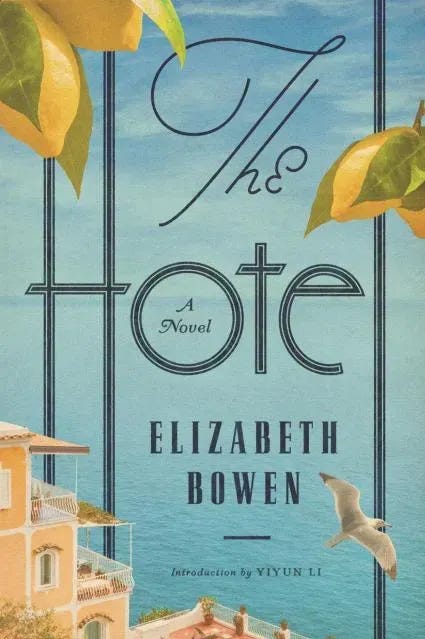
The Hotel. By Elizabeth Bowen. New York: Union Square & Co., 2026. 256 pp. $17.99.
Elizabeth Bowen’s first novel is a queer one. Near its center, maybe at its true center, is the friendship between a clever, vivacious young woman and an odd widow, Sydney Warren and Mrs. Kerr, who stay among other upper class English at a hotel on the Italian riviera. Ostensibly it is a marriage plot, putting Sydney into close conference with an Anglican clergyman, Mr. Milton. Mrs. Kerr’s learned son Ronald, late to join the rest, is an important presence, too. As a marriageable woman in the years after the Great War, Sydney is caught between the old and the new, and so, as the publishers of this reissue claim, is The Hotel, somewhere between Jane Austen and Virginia Woolf. It contains a very strange proposal scene, in which the speakers are muffled, half hidden away in their own minds, and things are not resolved in the usual way. Bowen allows it to appear that they never will be. The novel opens and closes with scenes from another fraught friendship between two more conventional, though unmarried women, Miss Fitzgerald and Miss Pym. The hotel, even as it shrinks and takes on the look of a doll’s house, draws them back: there is no way forward.
Bowen is just as committed to atmosphere as a Gothic novelist, and in her created world, the heat of the day and the arrangement of rooms seem to command the manners of her people. As one excitable young woman, a reader of H. Rider Haggard, tells Sydney, the stifled sorts in hotels are “hardly alive”, but there is another kind of life, defined not by enterprises and major incidents, but by perceptions. Are these to some degree controlled by the perceiver? For the less imaginative, the only way out of atmosphere seems to be by lapsing into lassitude, or being otherwise adjusted. Mr. Milton, whose social skills are trained in the parish hall, not among this fashionable set, encounters a real character, a Mrs. Kerr, and sees that there is more: “The crude and vivid glitter of the lounge, the hard light striking with an impact almost audible on glazed stuffs, noisy colours, reddened skins, the urgent hum of talk,” all these to be replaced by “tempered lamp-light and clear gloom” as he continues his muddled conversation with Mrs. Kerr about Sydney. Bowen keeps up the social dance which underneath its showy ease is rather complicated, but she records the remote visions and stray thoughts that accompany each person through all that motion. That almost audible light, those noisy colours, are synesthetic experiences that other characters share, but which are surely different for each of them. The crossing of the senses is a personal affair, but it is universal too.
In passing, mental images interpose strangely between speech and action, those two sturdy elements of narration. This requires metaphor that can first appear mannered, odd for the sake of showing that the author has her own odd vision, but if the reader is in the right suggestible mood, the following can work: “Miss Pym, waiting about in the lounge, glanced back diffidently at the last few minutes”; “‘Anyone can have him, as far as I am concerned.’ She dangled an imaginary Victor airily, as though he were a marionette.” Thoughts, indulged in the half privacy of brief silence, take on visual form as prompted by memory or the surrounding scene. Veronica, the loose girl who dismisses Victor, has seen the jerking motion of a marionette somewhere, maybe at the hotel. The fanciful image is written in so casually that it appears to be hers, and not the author’s.
The truths of relationships are semi-private, and the view available to Bowen’s bystanding characters is rather limited. The Kerrs have sense and style, but no one has anything like the author’s omniscience. When a character’s ideas are to be applied to people in the abstract, not to a nearby Victor, Bowen makes them look pretty dubious. Miss Pym, like Mr. Milton intimidated by Mrs. Kerr, tries to say something to her about life and leisure, and her important nouns are done up, mock 18th century style, with capitals:
“But I do think that to the Straightforward Person who can be frank with themselves and admit that they do like to escape the difficulties of Life and the unpleasantness—if they can do so without depriving themselves of Experience or evading Responsibilities, or hurting Other People—then . . .”
Miss Fitzgerald had enjoyed this sort of thing, but Mrs. Kerr, wisely it seems in Bowen’s opinion, is skeptical, allowing Miss Pym’s speech to trail off into the afternoon quiet. Sydney’s mind, because of her nature as much as the advantage of youth, is more energetic and agile, and she doesn’t need to dress up all her thoughts in dignified four-syllable words. To her, Miss Pym is one of the “pussies”, foolish and talkative older women who perhaps belong in an Austen novel, and Mrs. Kerr alarms Sydney by associating herself with Miss Pym as a coeval. Later we learn that Sydney may have developed a further human taxonomy in which “pussies” figure, but privately, not even for Mrs. Kerr’s hearing. In the middle of a conversation with her cousin Tessa, she reminds herself that other people “had thoughts too (with these she often forgot to credit them). Did they also think as they looked at oneself? The strangeness is that a cat can look at a king and see him; we kings forget so often that cats are more than objective.” Who else besides herself could Sydney be referring to with her “we”? If this is Bowen’s conscription of the reader, it is perhaps both flattering and disquieting.
We will be lead to feel that Mr. Milton, like Mr. Elton, is a mediocrity unworthy of our heroine, being no cat but less than a king. That said, lifting up and out of the close third person, the novel occasionally uses something of the same impassive yet exhilarating omniscient voice found in Woolf, and when it does, such distinctions no longer seem to matter. Merely by changing, the elements assert themselves as a reminder of an equality that Sydney at least is not ready to see. When the rain falls, personality is lost in a common response: “Sleep, the thin uneasy sleep of daylight, had to-day been the refuge of many, for cold rain fell ceaselessly past the windows.” The author, a different sort of being, does not sleep, but records images of a clarity that would be too much for the characters to bear. When fine weather returns, we are reminded of everything solid. “Against an opaque, bright-blue sky the expressionless faces of the buildings had again their advertised and almost aching whiteness. The sounds like the shadows were exact and clear-cut, no longer blunted by the rain.” For anyone looking and hearing, the senses are not confused as in the riot of the lounge, but working in concert. That day, Sydney is seen coming out of a flower-shop into the shadowed side of the street. Does she quite see where she is?